Anyone with even a passing interest in popular music has probably seen Marshall guitar amps sharing the stage with many of the world's greatest rock bands. Since 1962, the iconic look and logo of these venerable road warriors has let everyone know there's some serious guitar shredding on the way.
More recently, Marshall licensed Sweden's Zound Industries to manufacture headphones and Bluetooth speakers bearing the Marshall brand, including the Marshall Stanmore II Voice reviewed here. The "Voice" in the name indicates that it responds to voice commands, and it comes in two different versions: Amazon Alexa and Google Assistant. I had the Alexa version for review. After some trouble getting everything working, the speaker sounded quite good, especially playing rock music.
Features
The Marshall Stanmore II Voice looks just like the amp head for a Marshall stack. It's not exactly small, measuring 13.78 x 7.68 x 7.28 inches (WxHxD) and weighing a hefty 10.47 pounds.
 Scott Wilkinson / IDG
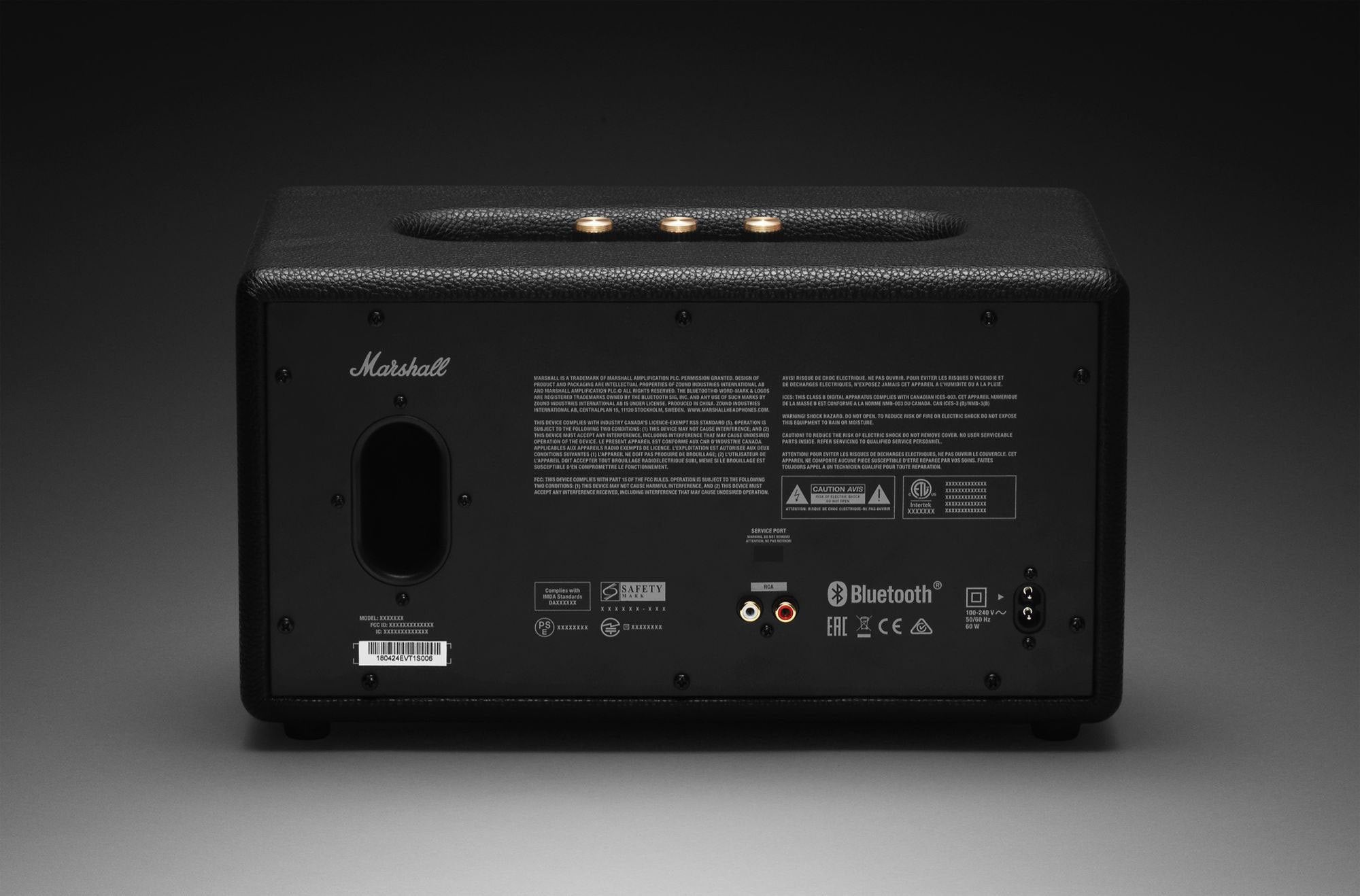
The back panel includes a bass-reflex port on the left, a pair of RCA jacks, and the power-cord receptacle.
The bass-reflex cabinet houses two 0.75-inch damped-fabric dome tweeters and one 5.25-inch coated-paper cone woofer facing forward with a port on the back, so don't place it right up against a wall or other surface to avoid overemphasizing the bass—unless you're into that sort of thing! The specified frequency range extends from 50Hz to 20kHz (±6dB) with a maximum output of 101dB SPL at a distance of one meter. The woofer is driven by 50W Class D amplifier, and each tweeter has its own 15-watt Class D amp.
One primary feature is integrated Amazon Alexa or Google Assistant voice control—my review unit uses Alexa—which requires access to your Wi-Fi network. The Stanmore II Voice can join any 802.11b/g/n/ac network at 2.4- or 5GHz with WPA security. This lets it stream music from various online providers, such as Amazon Music, Spotify, Tidal, Deezer, Pandora, and others. In addition, you can control other compatible devices, such as TVs, lights, locks, thermostats, and so on. A far-field two-microphone array with noise cancellation allows it to hear you even when the music is turned up or you're across the room.
In addition to online streaming, the Stanmore II Voice can also accept audio via Bluetooth. The speaker implements Bluetooth 4.2 and supports the A2DP, AVRCP, and HID profiles; it does not support the aptX codec. Another wireless "input" is Spotify Connect, which streams audio from a device with the Spotify app directly to the Stanmore II Voice via Wi-Fi. In addition, the unit provides two physical inputs: a 3.5mm jack on the top and a pair of RCA jacks on the back. It supports audio resolutions up to 192kHz/24-bit.
With a recent firmware update, you can assemble a multi-room speaker system that can play different tunes in each room or the same song throughout your home. Using your Wi-Fi network, Alexa Multi-Room lets you combine compatible speakers from different brands into a multi-room system.
 Zound Industries
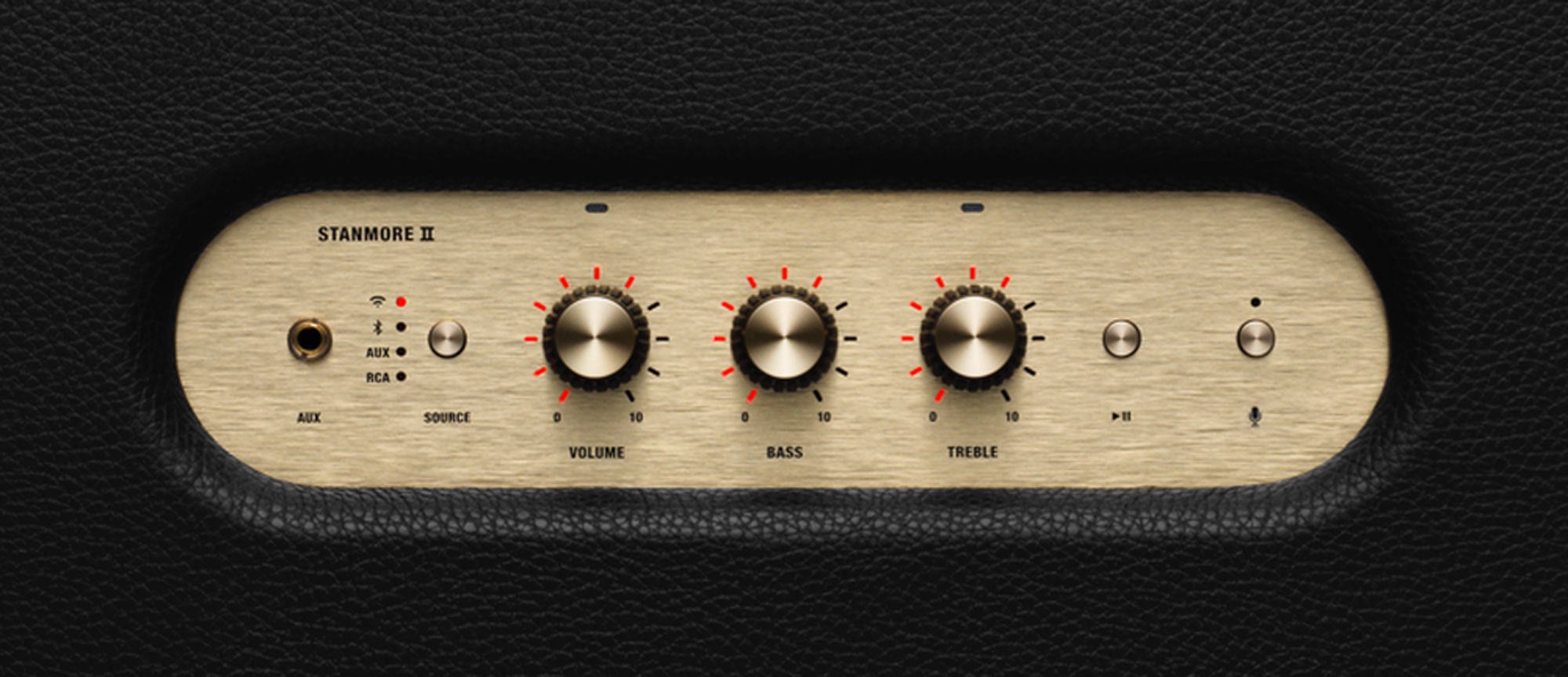
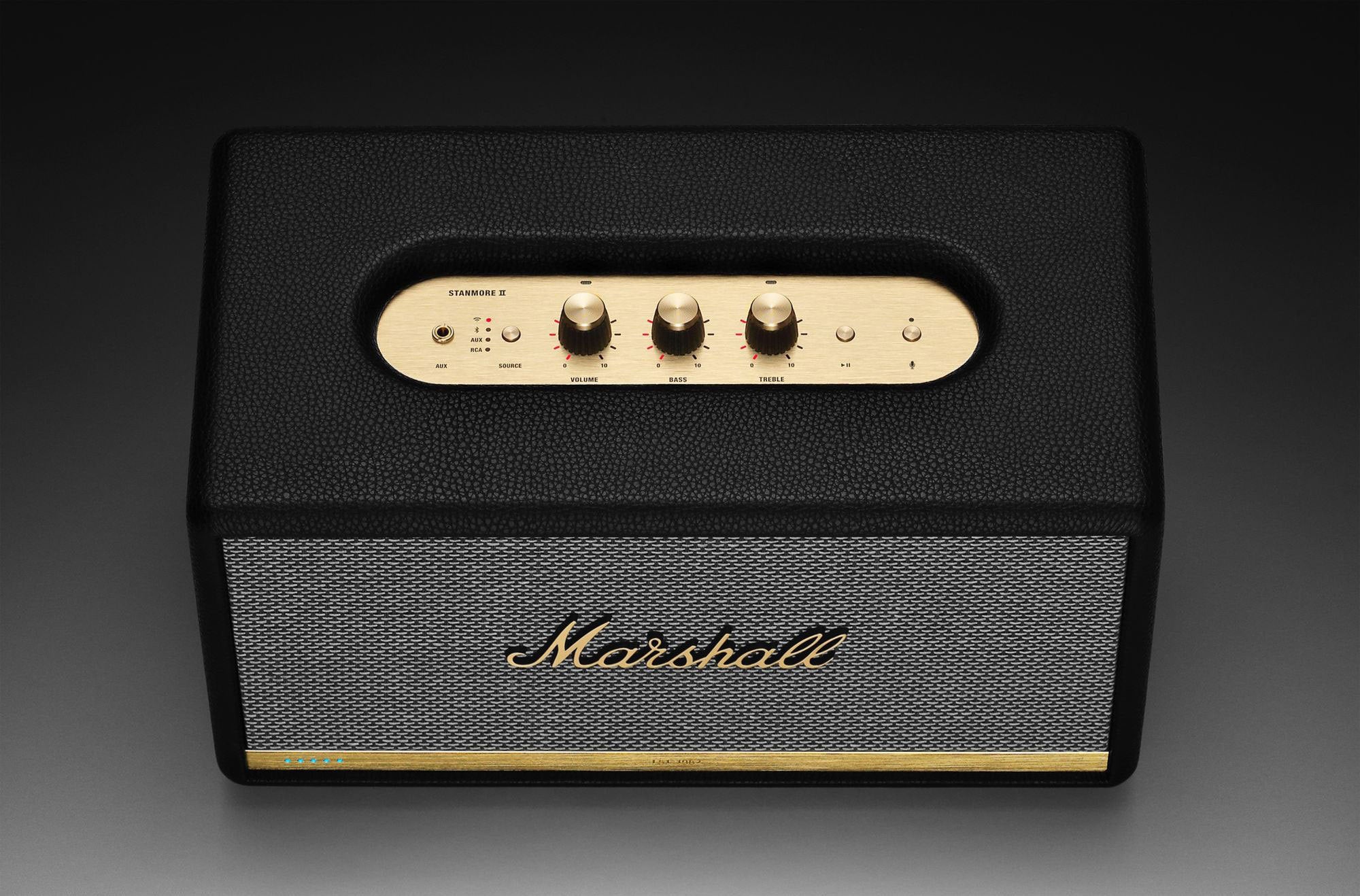
On the top of the unit (L-R) are the 3.5mm aux input; source-selection button; volume, bass, and treble controls with super-cool illuminated setting markers; play/pause/skip button; and microphone activation/mute button. Above those controls are two microphones for voice commands.
User Interface
The top of the unit sports several physical controls, including a source-selection button, volume knob, bass and treble knobs, a play/pause/skip button, and a microphone button that activates Alexa or Google Assistant without having to say the wake word. The microphone button also mutes and unmutes the two mics, which are mounted on the top as well. The volume, bass, and treble knobs are each surrounded with markers that light up one by one as you increase the settings, which is way cool.
Aside from the top-panel controls and voice commands, you can operate the Stanmore II Voice with the Marshall Voice app. Also, you must use the app to set up the speaker. In fact, the included "manual" says only to download the app and follow the onscreen instructions—nothing else! You can download the full manual if you want it.
Once the speaker is set up—which I discuss below—the app is super simple. The Stanmore II Voice appears in the main screen with a volume slider; tapping the speaker's icon brings up a screen that lets you select the input (Wi-Fi, Bluetooth, Aux, RCA). The Wi-Fi screen includes play/pause and skip to next/previous track buttons as well as a volume slider and playback-progress bar. The Bluetooth, Aux, and RCA screens have only a button labeled "Activate," which merely selects the corresponding input on the speaker.
 Scott Wilkinson / IDG
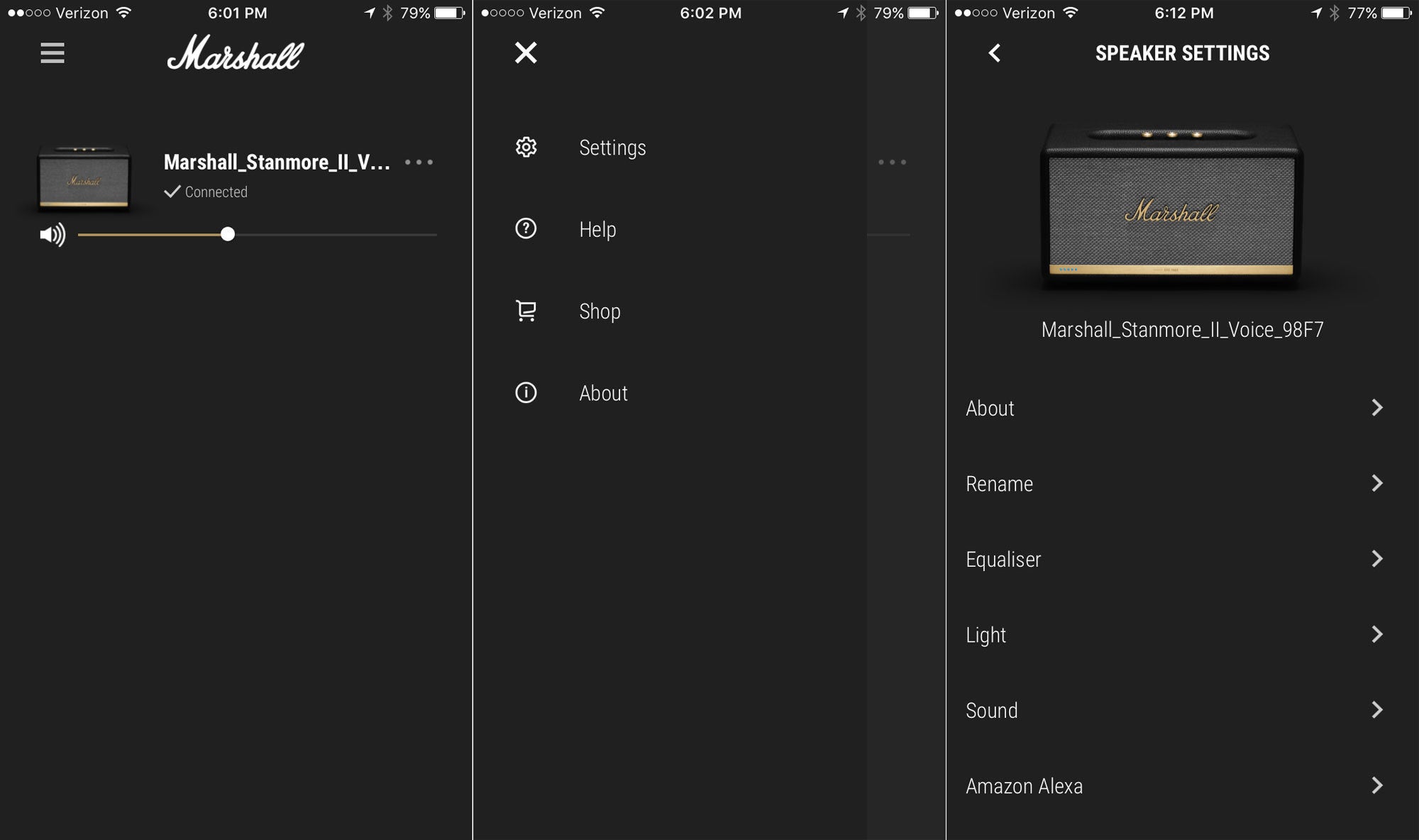
After setup, the Marshall Voice app's main screen shows the speaker and a volume slider. Tapping the menu icon in the upper left opens a screen with Settings, Help, Shop, and About. Tapping the three dots next to the speaker's name opens a Speaker Settings screen. The most interesting item in this screen is the Equaliser (spelled that way because the parent company is located in Europe).
Next to the speaker's icon are three dots. Tapping on them opens a Speaker Settings screen with items that let you rename the speaker; apply equalization with a five-band graphic EQ; set the intensity of the lights around the volume, bass, and treble controls; enable or disable the power-on sound; and sign into your Amazon account. It did not let me sign into Amazon from my phone, however; instead, it showed a blank white screen. As I discuss below, it took two customer-support reps and the product manager to solve the problem—sort of.
Tapping the menu icon in the upper left opens a menu with four items: Settings, Help, Shop, and About. The Settings screen has only one item that lets you enter your email address to subscribe for updates, special offers, and "inspirational reads" (whatever that means). Why is this screen called "Settings"? The real settings are in the other menu. The Help screen offers a Quick Guide, the online manual (which requires you to establish an online account), and a contact screen that also requires you to have an account with Marshall.
Setup
Opening the Marshall Voice app for the first time, it starts with a few feature-touting screens, and then asks for your email address, which you can skip. Next, the app searches for speakers, after which it displays step-by-step instructions on how to set up the speaker(s) it finds.
This all went smoothly on my iPhone 6, but immediately afterward, the app displayed a blank white screen. Even stranger, the problem seemed to correct itself after a few days. When I said the magic word "Alexa," however, the speaker said, "Login unsuccessful. Please log into your Amazon account in the companion app." Unfortunately, I saw nothing in the Marshall app that would allow me to log into my Amazon account.
 Scott Wilkinson / IDG
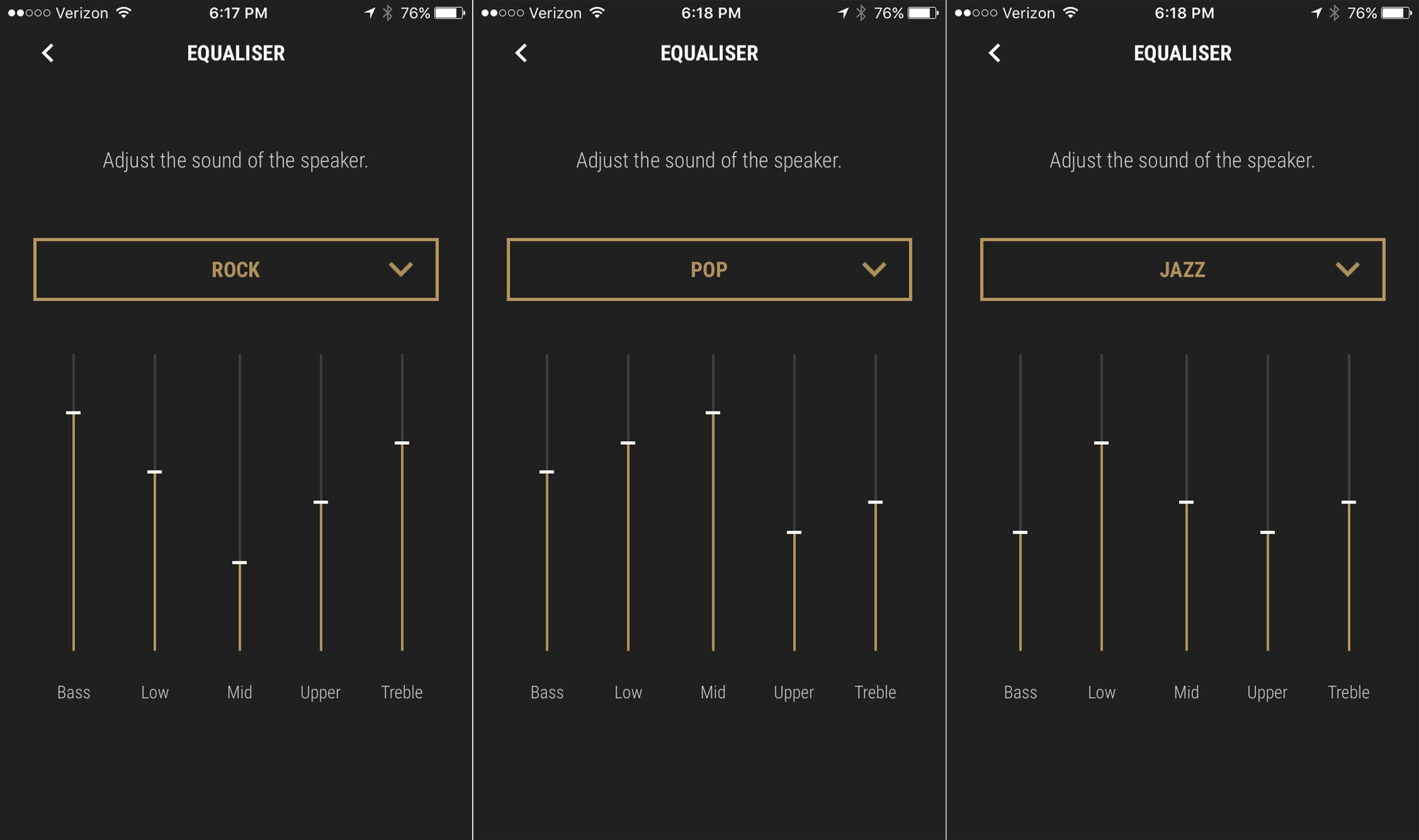
The Equaliser screen offers a five-band graphic EQ with six presets for different musical genres as well as Flat and Custom. Here, you can see three of the presets.
Another problem was that the Stanmore II Voice didn't show up in the list of Bluetooth devices on my iPhone, though it did show up in the Bluetooth list on my iPad. Later, it showed up on the iPad but not the iPhone. I made sure it wasn't paired with another device, but that did not solve the problem.
Even worse, the customer-support function on the Marshall website is a joke. There is no phone number to call, only a support popup that lets you type in your question and provides links to various support pages that might—or might not—address your problem. It didn't address mine.
The one saving grace is a live-chat function, which I tried next. The first customer-support rep I chatted with was unable to help because he didn't have a Stanmore II Voice with Alexa available. The second rep had me do a factory reset on the speaker and set it up again in the Marshall app. That seemed to work exactly as it did the first time—including a blank white screen when it was done!
The second rep informed me that an Alexa sign-in screen should appear immediately after setup, not a blank white screen. He checked whether or not the app is compatible with my phone and its OS—it is. He instructed me to delete the Marshall Voice and Alexa apps and reinstall them, which I did. Then, he had me do another factory reset on the speaker, restart the phone, and set up the speaker yet again. The result was the same—a blank white screen instead of the Alexa app after setup.
 Zound Industries
The Marshall Stanmore II Voice is lovingly modeled after Marshall guitar amplifiers.
I ended up speaking with the product manager, who was at the parent company's headquarters in Stockholm, Sweden. He suggested that I install the Marshall Voice app on a different device, so I installed it on my iPad. After going through the set-up routine again, I finally saw the Amazon sign-in screen, not a blank white screen. I signed into my Amazon account, and everything seemed to work correctly.
The product manager said the company had confirmed that the app was compatible with the iOS version on my phone, but they don't have every device that can run it, and they had not tried it on an iPhone 6. The iPad was running a later version of iOS, which worked fine.
Performance
Before getting into some serious listening, I tried out some Alexa voice commands, which worked with no problems. I asked Alexa for the local weather (rain tomorrow) and to play some tunes. All went exactly as expected.
For most of my listening, I used Bluetooth from the iPad. I started with some folk/world music, including "Searching for Lambs" from John Renbourn's album Ship of Fools, and "Rewind" from Oregon's album Beyond Words. Both sounded nice and rich, especially the guitars, but the acoustic bass on the Oregon track was slightly congested. Turning down the physical bass control helped a bit, but at the expense of deep bass frequencies.
I got a better result using the Marshall app's five-band graphic EQ. It defaults to Flat, but turning down the Low band (second to lowest) helped clear up that congestion.
 Zound Industries
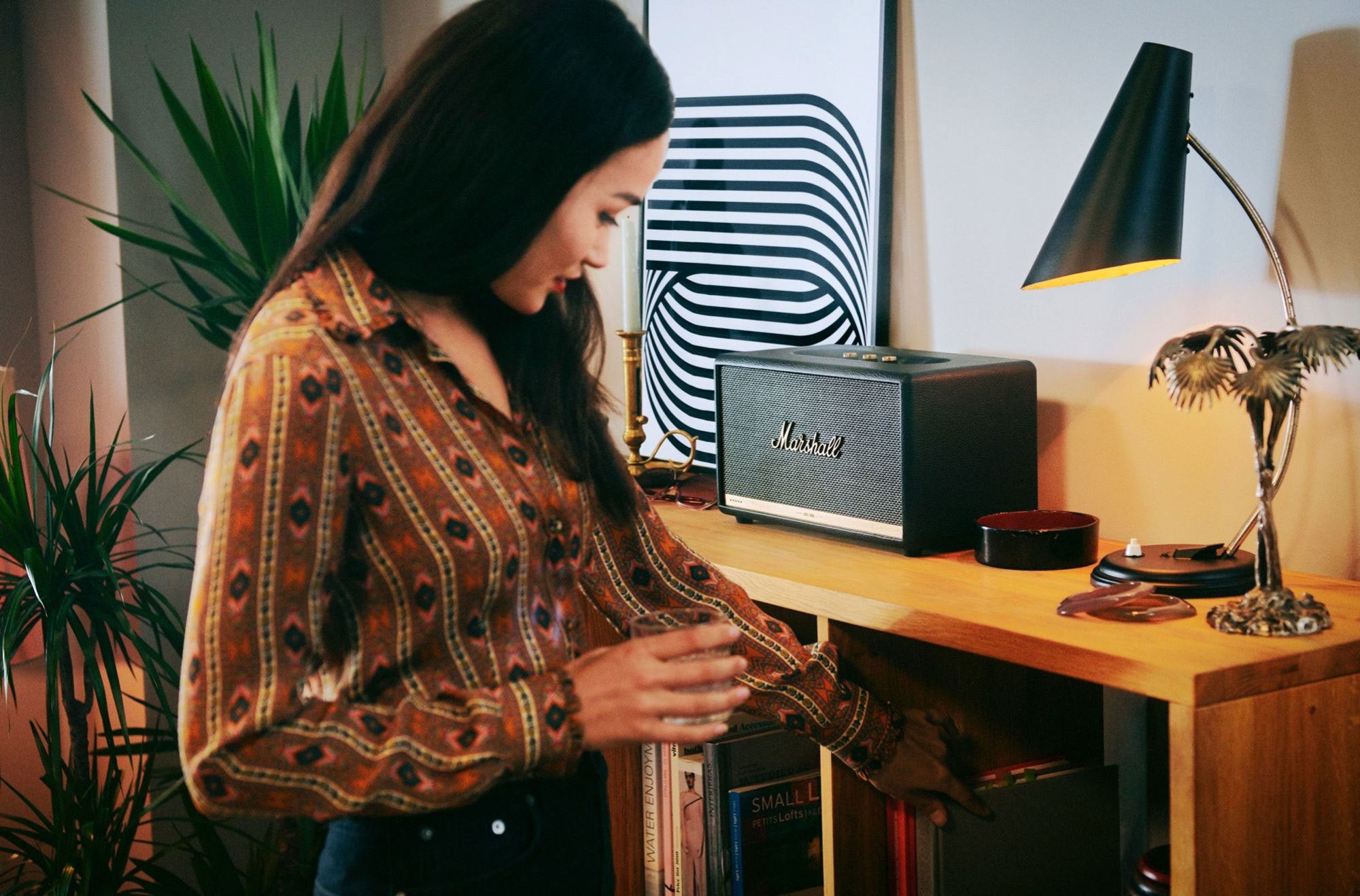
We wouldn't recommend placing the Marshall Stanmore II Voice this close to a wall, because its bass-reflex port will cause bass frequencies to be heavily overemphasized.
For some serious vocals, I checked out "Weeping" from Josh Groban's album Awake (featuring the vocal ensemble Ladysmith Black Mambazo and singer Vusi Mahlasela) as well as "Spem in Alium" by Thomas Tallis as performed by The King's Singers on their album of the same name. In both cases, the vocals were clean and nicely rendered, though slightly congested in the lower midrange with flat EQ, so I went back to my tweaked Low setting, which helped. Also, Groban's lead vocal was a bit recessed in the mix, but the dynamic range was good.
Turning to good ol' rock 'n' roll, I played "Sweet Home Alabama" from The Best of Lynyrd Skynyrd and "Ohio" from Neil Young's Greatest Hits. The Stanmore II Voice was clearly in its element, sounding rich and smooth. Young's lead vocal seemed slightly veiled, but still, this speaker works well with rock as befits its heritage. I tried the Rock EQ preset with these tracks, which boosted the bass considerably—too much for my taste.
Next up was some classical music. I listened to the Pastoral Symphony from Handel's Messiah as performed by the London Philharmonic under John Alldis as well as "You've Got to be Carefully Taught" from the new Broadway cast recording of South Pacific. (I know, South Pacific isn't really "classical" music, but it does have an orchestra, so close enough!) On the Handel, the Stanmore II Voice sounded somewhat restrained with underwhelming bass, though the orchestral sections were fairly well rendered, and the overall sound was warm. Likewise with the tune from South Pacific, which exhibited clean vocals and orchestra. The vocals, however, were not as out front as I'd like. In this case, I boosted the Bass (lowest) band in the EQ slightly, which helped bring out the lowest frequencies.
 Zound Indsustries
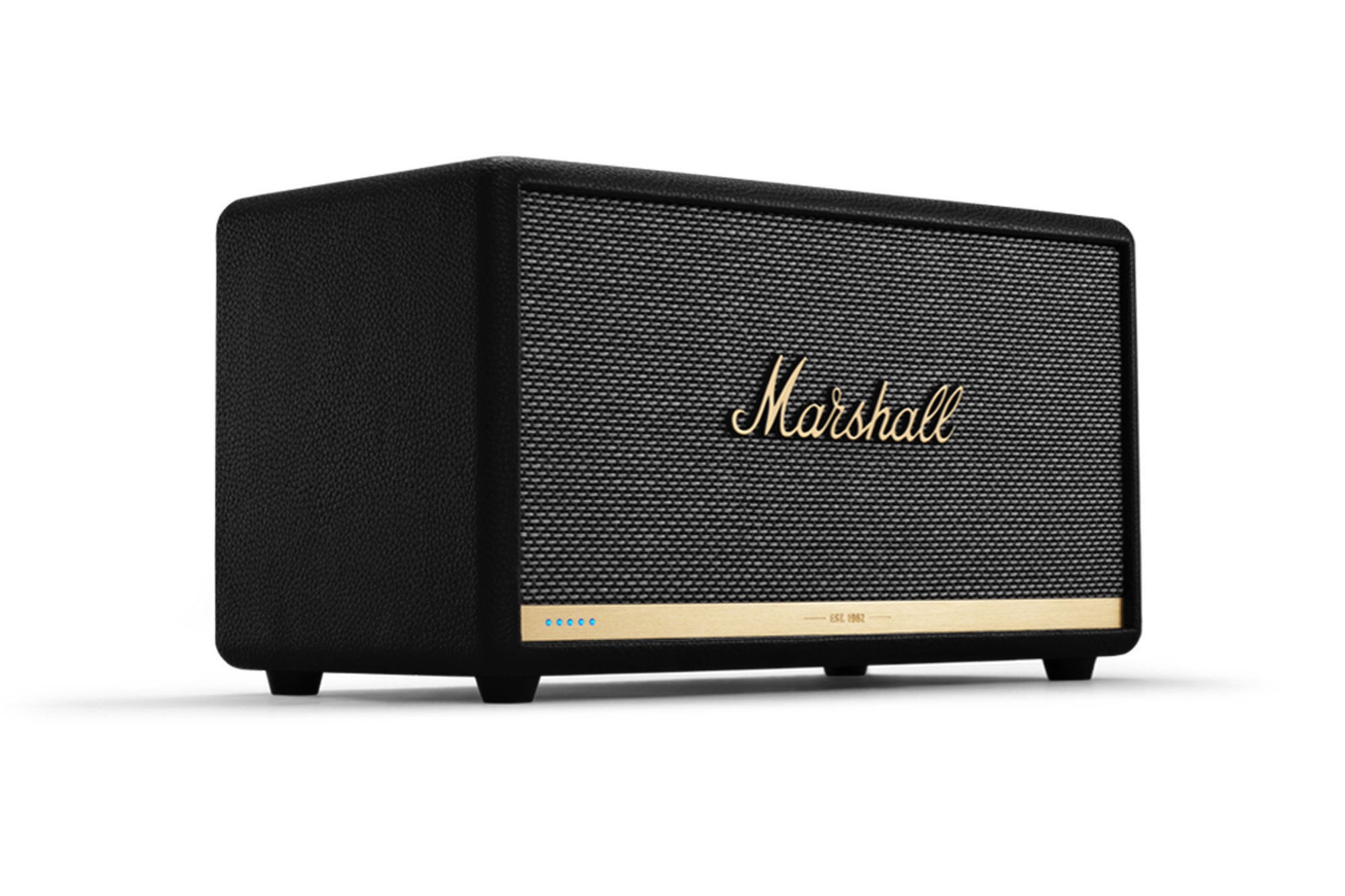
Appropriately enough, the Marshall Stanmore II Voice sounds best when playing rock-and-roll music.
Comparison with Klipsch's The Three
I compared the sound of the Stanmore II Voice with that of Klipsch's The Three, which I still had on hand after reviewing it for TechHive. Overall, The Three had a somewhat leaner, clearer sound, and I could hear deeper into the mix.
I couldn't ignore The Three's boxy quality, however; the Stanmore II Voice also sounded a bit boxy, but less so than the Klipsch.
Lead vocals were more up-front on The Three, and vocal ensembles sounded more balanced. But its sound was more polite than the Marshall's on rock music. Interestingly, I thought the Klipsch sounded more aggressive and a bit colder on classical music.
Bottom Line
In my listening, the Marshall Stanmore II Voice performed best with rock—which makes sense, given its heritage. Its sound isn't quite as well suited to more polite tracks, though the five-band EQ can help. It certainly doesn't sound bad playing other types of music, but it really shines when it's rocking out.
The five-band graphic EQ is one of the coolest features of this speaker; I wish other such products would include something like it. It lets you tailor the sound to your liking, though it's inconvenient to adjust the EQ for each tune. After listening to the presets on a variety of material, I decided to leave it on Flat with a slightly decreased Low setting, which gave the best result overall to my ears.
Unfortunately, the app's behavior with my iPhone and iPad was somewhat erratic. Aside from the problems I had with signing into Alexa on my phone, I could pair it with one device and not the other via Bluetooth, and some time later, those roles reversed.
If you're an avid rocker, the Marshall Stanmore II Voice makes a clear visual statement attesting to that fact—and it sounds great playing your favorite genre. Those who prefer other types of music might not find its obvious relationship to rock as appealing, but the sound is still quite good—and the five-band graphic EQ can make it even better.
At nearly $400, it ain't cheap, but it's $100 less than Klipsch's The Three. Which one sounds better? That depends on your taste; the Klipsch is cleaner, leaner, and more balanced overall, but it sounds more boxy than the Marshall. And the Stanmore II Voice has the five-band EQ, which give it a fairly big edge. In the end, it will probably come down to which one you think looks better in your home's decor.

Không có nhận xét nào:
Đăng nhận xét